

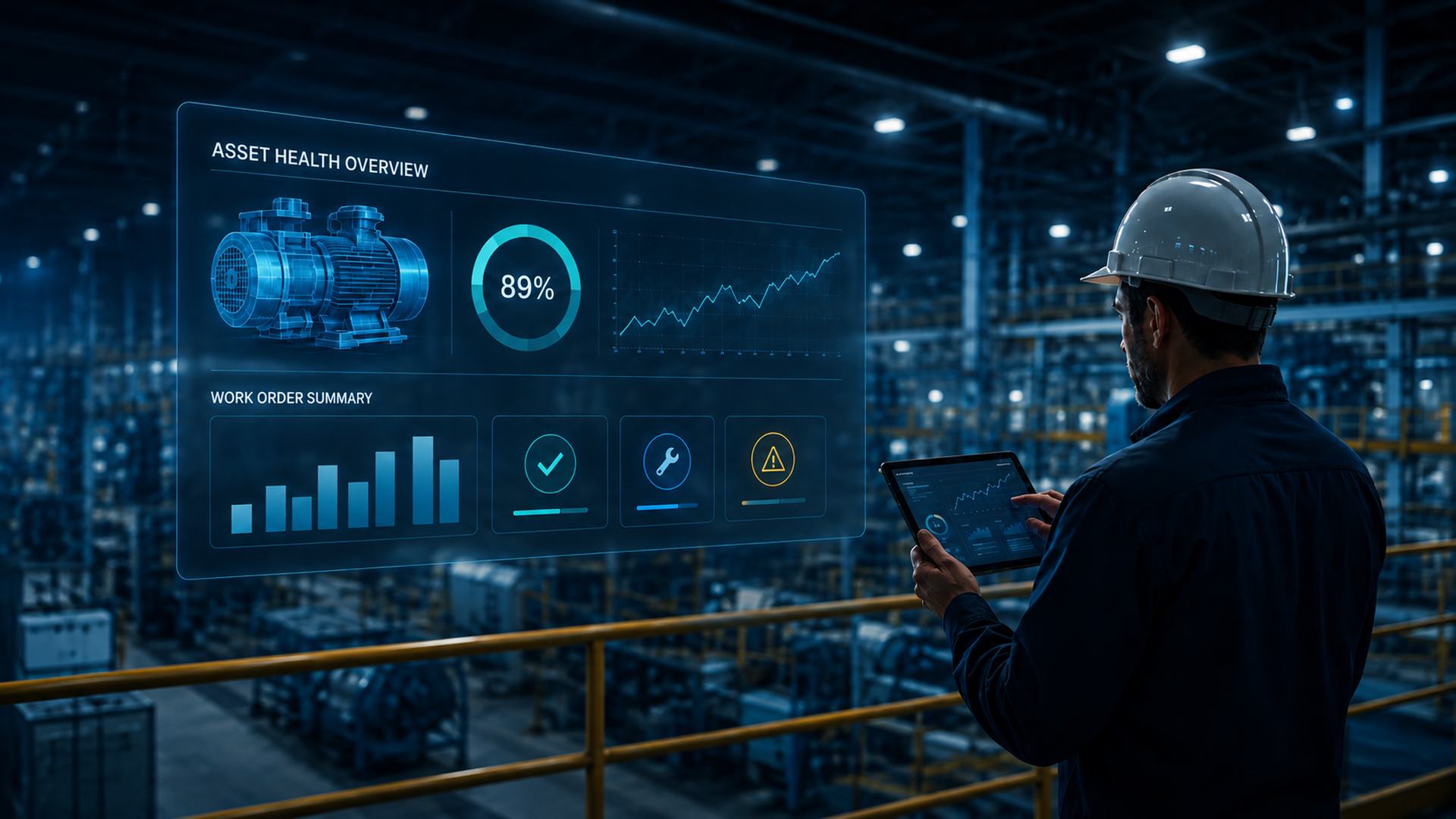
Ask most maintenance teams what AI means for their work and you’ll get one of two reactions: excitement about a future of machines that fix themselves, or scepticism that it’s another buzzword layered onto software that already does what it needs to do. Neither is quite right. The real shift is quieter than either version, and it’s already happening inside the systems teams use every day.
We see this through IBM Maximo Application Suite. Maximo is a useful example precisely because it isn’t a new AI product bolted onto old software. It’s a long established enterprise asset management platform that’s had AI and IoT capability built into its existing modules, so the change shows up as a shift in how the platform behaves, not a separate tool teams have to learn.
From records to signals
Asset management has always been about data: work orders, maintenance histories, inspection logs. What AI changes isn’t the presence of that data, it’s what the data can now do on its own. A maintenance log used to be a record of what happened. Increasingly, it’s an input that can flag what’s about to happen next.
That’s the real move: from asset management as documentation to asset management as prediction. Sensor readings, work order patterns and inspection notes that used to sit separately can now be read together, and that combination is what surfaces a failing part before it fails, not after.
Reactive to condition based
Most maintenance still runs on two speeds: scheduled servicing on a calendar, and emergency fixes when something breaks in between. AI doesn’t remove either of those, but it adds a third option, condition based maintenance, where the trigger is the actual state of the asset rather than a date on a calendar or a breakdown on the floor.
For teams managing hundreds or thousands of assets, that’s a meaningful change in how work gets prioritised. Instead of treating every asset the same way on the same schedule, the ones showing early signs of wear move up the list, and the ones running fine get left alone. Less wasted maintenance, fewer surprises.
This is Maximo’s condition centered maintenance in practice. It’s a named capability of the platform, built to move teams away from run to failure or purely calendar based servicing. However, it depends on the asset actually feeding in IoT or sensor data. For equipment that’s already connected, Maximo can act on real time condition. For legacy equipment that isn’t yet instrumented, this is a capability to grow into rather than something switched on for every asset from day one.
Faster diagnosis, not automatic decisions
A common misconception is that AI is stepping in to make the calls maintenance engineers used to make. In practice, it’s doing something narrower and more useful: cutting the time between a symptom appearing and someone understanding what it means. Pattern recognition across historical failures can point an engineer toward a likely cause faster than manually checking back through logs, but the decision on what to do about it still sits with the person who knows the asset, the site and the operational context.
That distinction matters. The organisations getting real value out of this aren’t the ones expecting the software to run maintenance on its own. They’re the ones using it to give their teams better information, faster, so people can spend less time diagnosing and more time fixing.
Maximo’s anomaly detection works the same way. It’s built to flag that something’s drifting from normal, not to decide what happens next. The engineer still makes the call. What changes is how early they get the flag.
Where this actually lands
None of this works without the groundwork most organisations underestimate: clean, connected data. Predictive tools are only as good as what’s feeding them, and for a lot of teams, the biggest blocker to getting value from AI in asset management isn’t the technology itself, it’s fragmented data sitting across systems that were never designed to talk to each other.
That’s usually where the real work is. Not switching on a new feature, but getting the underlying data into a state where prediction is even possible. It’s less exciting than the AI headline, but it’s the part that decides whether any of this pays off.
If you’re weighing up what AI could realistically do inside your own asset management setup, we’re always happy to talk through where the value is likely to show up first, and where it isn’t yet. As an IBM Maximo partner across Ireland and the UK, this is the conversation we have with clients regularly, usually starting with the data, before we get anywhere near the AI.