


The ability to navigate periods of change is critical for any business – whether it involves introducing new technologies, redesigning internal processes or restructuring teams, particularly when replacing legacy systems. Yet when employees find it difficult to adopt new ways of working, even initiatives that look great on paper struggle to deliver value, or fail completely.
These difficulties often arise because leaders underestimate how much the change will impact their teams. If employees don’t receive clear communication about why something is changing, how it will affect their role and what support they will receive, their initial uncertainty can turn into resistance, disengagement or a return to familiar workarounds.
The scale of the challenge is reflected in recent research: only 42% of UK employees think their employer is good at helping them adapt to change. When organisations fail to provide the right support, uncertainty can make it harder for employees to engage with new systems and processes.
An effective change management strategy helps to address these challenges. It connects the technical work of implementing new systems with the practical task of preparing people to use them. In practice, that means bringing data, systems and people together: making sure the data is clean and trusted, the system fits how teams actually work, and the people using it are ready and supported. For organisations implementing technology, team structures and ways of working, a good change management process ensures staff are onboard, continue to be productive, and don’t leave at this crucial time.
This article looks at the common challenges around change management, what an effective process looks like, and how an experienced data and systems intelligence consultancy can help you to implement the plan while minimising the risks.
Organisational change is necessary when existing systems, processes or structures no longer support the business’s needs.
Employees may resist change when they feel uncertain about its purpose, the effect on their roles or their ability to adapt.
Successful change depends on preparing employees for new ways of working alongside implementing them. Imposing change without involving your teams can leave employees feeling unsupported and make it harder to integrate new ways of working.
Training, clear communication and ongoing support help employees adopt new systems and sustain improvements after implementation.
An experienced change management consultancy helps employees adapt to new systems and processes, so the organisation can realise the benefits of its investment.
When does an organisation need to change?
Organisations usually undergo a period of change when their existing systems or structures are holding them back. A change strategy will also be drawn up to respond to external factors – such as a new regulation, shift in the market or technological advance.
In other cases, leaders recognise that current processes consume too much time, produce unreliable data, or no longer support the organisation’s long-term needs, so begin the process of change in order to modernise their technology estate.
Common reasons for organisational change include:
- New technologies: Introducing an enterprise resource planning (ERP) system, asset management platform or customer relationship management (CRM) system to replace outdated software or improve access to information.
- Improving operations: Revising processes and approval arrangements to reduce delays, eliminate duplicated work and clarify responsibilities.
- Regulatory compliance: Updating systems and procedures to meet new legal obligations or maintain accurate reporting.
- Growth and restructuring: Changing reporting lines, team responsibilities or organisational structures as the business develops.
- Data and AI initiatives: Improving data quality, governance and integration to support reliable reporting and automation.
These changes can significantly impact employees’ working lives. A new asset management system, for example, may require maintenance teams to record information differently, use mobile devices in the field or follow revised procedures before closing a job. Elsewhere, finance teams adopting a new ERP system may need to change how they approve purchases or reconcile transactions.
AI and automation initiatives can also be disruptive if they are introduced without first laying the groundwork. Automated systems rely on accurate, well-governed data to produce reliable results. That starts with data that reflects how people actually work, giving teams a single, trusted source of truth rather than a patchwork of spreadsheets and side systems. If the underlying inputs are incomplete or inconsistent, automation can simply amplify existing errors and create additional work. Employees also need to understand how new tools work, how they will affect their responsibilities and when human judgement is still required. Proper training and clear guidance enables teams to use these technologies effectively and responsibly.
The technical changes proposed as part of a transformation may be clearly defined in a project plan, but employees will still need time and support to understand and adopt them.
Why do employees resist organisational change?
Even the most necessary and popular change can cause uncertainty within an organisation. People become familiar with established systems and procedures, and develop routines that they might struggle to part with – even if those routines are cumbersome or time-consuming.
Employees might resist organisational change for a number of reasons:
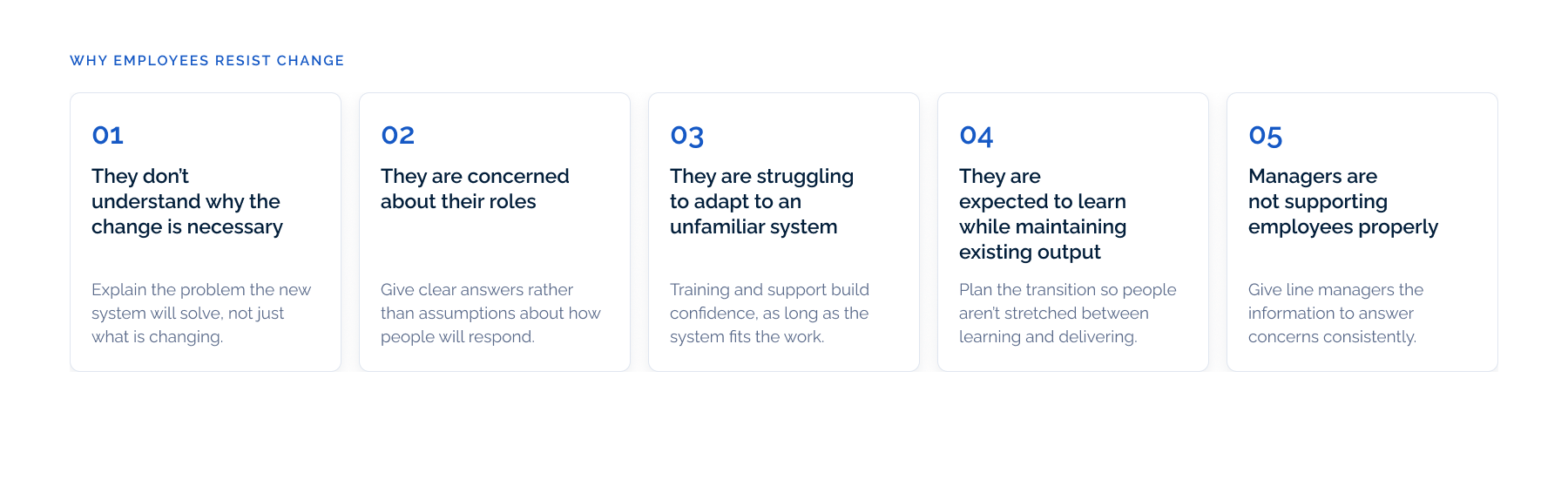
1.They don’t understand why the change is necessary
If leaders announce a new system without explaining the problem it will solve, employees may see the project as an unnecessary disruption. Explaining the business rationale helps people understand why their existing approach needs to change.
2.They are concerned about their roles
Employees may worry that automation will reduce their responsibilities, that new processes will make their jobs harder or that they will struggle to learn unfamiliar technology. These concerns need clear answers rather than assumptions about how people should respond.
3.They are struggling to adapt to an unfamiliar system
Replacing a familiar system can initially slow employees down as they learn new processes and get used to different ways of working. With appropriate training and support, they can become more confident over time. However, if the new system is a poor fit for what the organisation needs, employees may continue to struggle even after they have had time to adapt.
4.They are expected to learn while maintaining existing output
A new system may require staff to attend training, undertake unfamiliar tasks (including data analytics), and resolve early issues while continuing to meet normal service or production demands. Organisations need to manage the transition without disrupting essential services, delaying work or reducing their ability to meet existing commitments. Without careful planning, employees can end up stretched between learning the new system and keeping the business running.
5.Managers are not supporting employees properly
Line managers are often the first people employees turn to when they have questions or concerns. If they lack information about the changes, the implementation schedule or the support available, they may struggle to address concerns consistently.
These issues can reinforce one another. Employees who do not understand a change may engage less with training, leaving them less confident when the new system goes live. If they then struggle to complete their work, confidence can fall further.
Resistance is therefore useful information for project leaders. It can reveal gaps in communication, training, system design or operational planning. Understanding the cause gives the organisation a better chance of resolving the problem before it affects the wider programme.
What are the benefits of effective change management in an organisation?
Organisational change management is the structured process of preparing, supporting and equipping people to adopt a change in how an organisation operates, and typically includes:
- Assessing how the change will affect different teams and roles.
- Explaining why the organisation is changing and what employees can expect.
- Preparing managers to communicate the change and respond to concerns.
- Designing training around the tasks employees will need to complete.
- Giving employees opportunities to practise and raise issues before implementation.
- Monitoring adoption after go-live and addressing problems as they emerge.
There are several benefits to adopting a robust change management strategy, as detailed below.
1.Better adoption of new systems
Employees are more likely to use a new system confidently when they understand its purpose and have practised the tasks relevant to their roles. Training can address specific responsibilities, while feedback from users helps project teams identify issues before they become widespread.
For example, when an organisation introduces mobile asset management software, field teams need to learn how to access job information, record maintenance activity and submit accurate updates. If the new process is difficult to follow, employees may continue using old methods, leaving information incomplete or divided between systems.
“Manual workarounds are often seen as a temporary fix, but in reality, they more often than not become the operating model. Spreadsheets, side systems and human interventions fill the gaps left by disconnected core systems, and that creates inconsistencies at scale. For example, if you’re feeding in data that’s been manually tweaked, duplicated or interpreted differently across different teams, there will never be one single version of truth.”
Bobby Brown, founder and CEO, Nucleo
Change management helps organisations prepare employees for these practical adjustments and monitor whether teams are using the new system as intended.
2.Less disruption during implementation
Introducing new technology can affect productivity while employees learn unfamiliar processes. Planning training, phasing implementation where appropriate and providing support during the transition can reduce the effect on normal operations.
This is especially important in utilities, manufacturing and other environments where service interruptions can have financial, regulatory or safety consequences. Project teams need to understand which activities cannot stop, when employees can attend training and how the organisation will handle issues during implementation.
3.Better returns on technology investment
Organisations invest in new systems to make their operations more efficient, but those improvements depend on employees adopting the technology and the organisation adapting its processes to make full use of it.
For example, a reporting platform may improve access to data, but employees could still spend hours assembling reports manually if the organisation does not update the separate processes used to compile and produce them. Effective change management helps identify how people will use the new system and what needs to change for it to deliver value.
4.Clearer accountability and stronger project governance
Organisational change often involves several departments, each with different priorities and responsibilities. Without clear ownership, decisions can be delayed, problems can go unresolved and teams may disagree on what the project needs to achieve.
Effective change management helps define who is responsible for each part of the change, who makes key decisions and how teams should raise concerns. This gives leaders a better understanding of progress and helps them identify adoption problems that technical project updates might miss.
This is especially useful for complex programmes involving external suppliers, IT teams and operational staff. Leaders can check whether each team is ready for implementation and address any gaps before they cause problems.
How can organisations make change management successful?
Successful change management begins before implementation and continues after the new system or process goes live. The organisation needs a clear understanding of what will change, who will be affected and how it will know whether the change has achieved its intended results.
Several practical steps help establish that foundation.
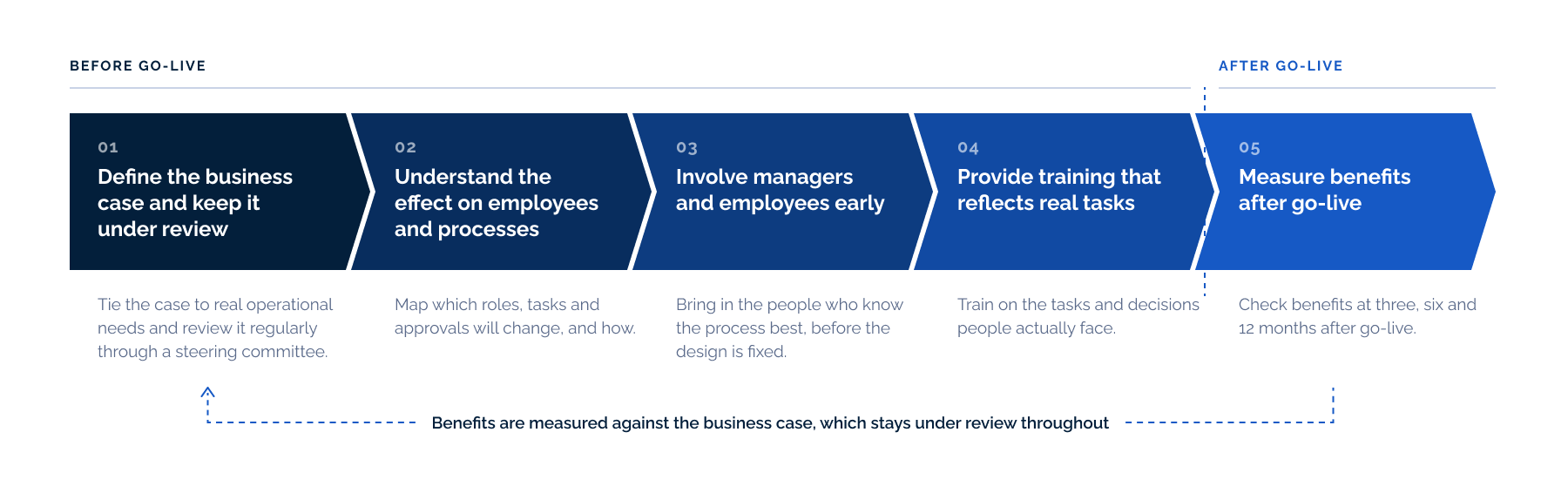
1.Define the business case and keep it under review
Leaders should be able to explain the problem the organisation is trying to solve and why the proposed change is necessary. This explanation needs to connect the project to real operational needs, such as reducing manual reporting, improving data accuracy or meeting a regulatory requirement.
But the business case shouldn’t be written once and filed away. It is a live document. Priorities shift during a project, and what made sense at the outset may not hold six months later. A steering committee should review it regularly throughout the programme, and be strong enough to change course when the evidence says it should. A clear business case gives employees context and helps project teams make decisions when competing requirements arise.
2.Understand the effect on employees and processes
Before implementation, the project team should examine how different roles will be affected. Which tasks will change? What information will employees need? Will approval responsibilities move between teams? Will staff need new equipment or access rights?
These questions help identify training needs, communication requirements and operational risks. They also give technical teams a chance to address problems with the proposed design before employees have to use it.
3.Involve managers and employees early
Employees often understand the practical details of a process better than those designing the replacement system. Involving them in discussions, testing and training can reveal issues that may not be apparent during technical design.
Managers also need sufficient information to explain the change to their teams. They should know what will happen, when it will happen and where employees can get help. Recent research found that 75% of UK transformations that lasted had managers who translated strategy into practical actions for their teams. In comparison, this happened in only 51% of transformations that eventually failed.
Consultation does not mean every employee will agree with every decision. It gives the organisation a way to understand concerns and address genuine problems before they undermine implementation.
4.Provide training that reflects real tasks
Generic demonstrations rarely prepare every employee for the situations they will encounter in their role. Training should reflect the actual tasks people will complete and the decisions they will need to make.
For a field service system, that might include receiving a job, accessing asset information, recording work completed and escalating an issue. For a finance platform, it could involve entering transactions, approving payments or reconciling records.
Employees also need access to support when they encounter unfamiliar situations after training. Practical guidance and timely assistance help them build confidence as they use the new system.
5.Measure benefits after go-live
A successful technical launch does not automatically prove that the organisation has adopted the change. Leaders need to check whether employees are using the system as intended and whether the expected operational improvements have followed.
Return on investment is rarely clear on go-live day, yet that is usually when the project team starts to disband. Delivering on time, on budget and to scope is no longer enough to call a project a success. Real success comes from documenting the expected benefits before the project starts, making sure they line up with the organisation’s strategy, and measuring them at regular check-ins after go-live, for example at three, six and 12 months.
Useful measures may include system usage, completion of training, data accuracy, task completion times, reporting effort, error rates or service interruptions. The right measures depend on the original business case.
Regular reviews help project teams identify where additional support is needed. They also allow leaders to assess whether the change has delivered the expected benefits and whether further adjustments are necessary.
When should you engage a change management consultancy?
An organisation may have the internal expertise to manage a relatively contained project. However, when a period of change affects multiple departments, involves complex technology or carries significant operational or regulatory risk, it is worth enlisting the support of a dedicated, external change management expert.
A change management consultancy may be particularly useful when:
- A major software implementation is approaching go-live and teams are not ready to adopt the new system.
- Employees are resisting a change and internal leaders need help understanding the causes.
- The programme has unclear responsibilities, competing priorities or limited visibility of delivery risks.
- Training and communication have been left until late in the project.
- The organisation has experienced previous implementations that failed to deliver their expected benefits.
- Existing project teams lack the capacity or specialist experience to manage technical delivery and employee adoption together.
External specialists can provide an independent assessment of readiness, identify gaps in the change plan and help coordinate activities across project delivery and operational teams. They can also give senior leaders a clearer view of risks that may not appear in technical status reports.
The choice of consultancy is important. You should look for a specialist who will take the time to understand your business and how it works, rather than relying solely on theoretical models or generic project plans. In a complex change project, such as a firm-wide IT implementation, change specialists need to understand what the new system will change in practice: how employees will access and use data, how existing processes will be affected, which responsibilities will change and where teams may need additional training or support.
This technical and operational understanding allows them to anticipate challenges early, prepare employees for specific shifts within their roles and help ensure the new system works for the people who depend on it.
How Nucleo can support your next change
Nucleo provides specialist support at every stage of organisational and technology change. Our services include:
IT project and change management
Managing technical delivery while preparing employees for new systems and ways of working.
Digital transformation and programme delivery
Leading complex, multi-team programmes from business case through to benefits realisation.
Strategy and organisational design
Reviewing business processes, responsibilities and structures to support your organisation’s future needs.
IT governance and compliance
Putting clear ownership, decision-making and controls in place so programmes stay on track and meet regulatory requirements.
Making sure your data is accurate, trusted and well managed before new systems or AI tools are built on it.
Embedded specialists
Providing experienced project managers, data engineers and change specialists to work directly within your teams.
Platform-specific implementation
Supporting the delivery and adoption of systems including IBM Maximo, Salesforce, Rootstock Cloud ERP and Aryza.
Ongoing support after go-live, so systems keep improving and teams aren’t left on their own once the project team moves on.
Organisational change management FAQs
The purpose of organisational change management is to help employees understand, adopt and sustain changes to systems, processes, structures or responsibilities. It includes assessing the effect of change on different roles, communicating the reasons for it, preparing managers, delivering relevant training and monitoring adoption after implementation.
Employees may resist change because they do not understand why it is necessary, are concerned about how their roles will be affected or lack confidence in their ability to use a new system. Poor communication, inadequate training and limited involvement in decisions can increase these concerns. Understanding the cause of resistance helps organisations respond with appropriate support and practical solutions.
Effective change management can improve adoption of new systems, reduce disruption during implementation and help organisations achieve the operational benefits they expected from a project. It also helps leaders identify risks earlier and clarify responsibilities across teams. Results should be measured against the project’s intended outcomes, such as reduced reporting time, improved data accuracy or fewer interruptions to service.
A technically sound system may still fail to deliver the expected benefits if it does not fit operational requirements or employees are not prepared to use it. Problems can include poor data quality, unclear process ownership, inadequate training and limited support after go-live. Integrating change management with technical delivery helps organisations address these risks before they affect adoption and performance.
A business should consider external support when a change affects multiple teams, involves complex technology, carries significant operational risk or exceeds the capacity of its internal team. A consultancy can assess readiness, identify barriers to adoption and coordinate change activities with project delivery. It can also provide independent support when an implementation is delayed, over budget or failing to achieve its objectives.